Dokra Art is one of India’s distinctive traditional metal crafts, known for its earthy appearance, intricate surface patterns and handmade lost-wax casting process. A Dokra sculpture does not begin with a block of metal waiting to be carved. Instead, the artisan first imagines and builds the form in clay and wax. That wax form is eventually replaced by molten metal, creating the finished object.
This process gives dhokra art much of its character. Look closely at an authentic handmade piece and you may notice that the lines are not mechanically perfect, the two sides may not be absolutely symmetrical, and another sculpture of the same subject may look slightly different. These variations are not necessarily flaws. They are often traces of the human hand and of a casting process in which the mold itself is sacrificed.
The Government of West Bengal describes Dokra as a craft involving clay, wax and molten metal and notes the difficulty of producing a complete replica through the traditional process.
Today, Dokra artisans create far more than traditional figurines. The craft appears in sculptures, jewelry, lamps, containers, wall pieces, table accessories and contemporary home décor. Yet its real importance goes beyond decorative appeal. Dokra brings together sculpture, metallurgy, design, inherited technical knowledge and visual storytelling in a single object.
Dokra Art History and Origin: How Old Is It?
Any discussion of dokra art history and origin eventually leads to the lost-wax casting tradition of ancient India. One of the best-known archaeological examples of lost-wax metal casting from the Indian subcontinent is the small bronze female figure popularly called the “Dancing Girl” of Mohenjo-daro, dating to the Indus Civilization.
That does not automatically mean that a present-day Dokra artisan belongs to one demonstrably unbroken craft lineage extending directly back to Mohenjo-daro. The more historically responsible conclusion is that the technology of lost-wax metal casting has extremely ancient roots in South Asia, while the Dokra traditions practiced today evolved within particular communities and regions over generations.
That distinction actually makes the history more interesting. What survived through centuries was not simply the appearance of one sculpture or one decorative style. It was an understanding of materials: how wax behaves, how clay responds to heat, how a mold must be constructed, how molten metal moves through it, and how a fragile model can eventually become a permanent metal form.
Official Odisha Tourism material also connects Dhokra handicrafts with India’s ancient lost-wax tradition and documents its continuing practice in Odisha.
Why Is It Called Dokra or Dhokra?
Readers frequently encounter both “Dokra” and “Dhokra,” and both spellings are widely used. The terminology has historically been associated with metalworking communities of eastern and central India whose craft practices spread across different geographical regions.
This regional spread explains why Dokra should not be treated as one rigid visual style. A sculpture made in Bankura can look different from a Dhokra object made in Odisha even when both rely on the same fundamental lost-wax principle. Local traditions, available materials, community practices and generations of individual artistic choices have created recognizable regional variations.
A better way to understand Dokra, therefore, is as a family of related metal-casting traditions united by process but diversified by place and community.
What Is Lost Wax Casting Technique?
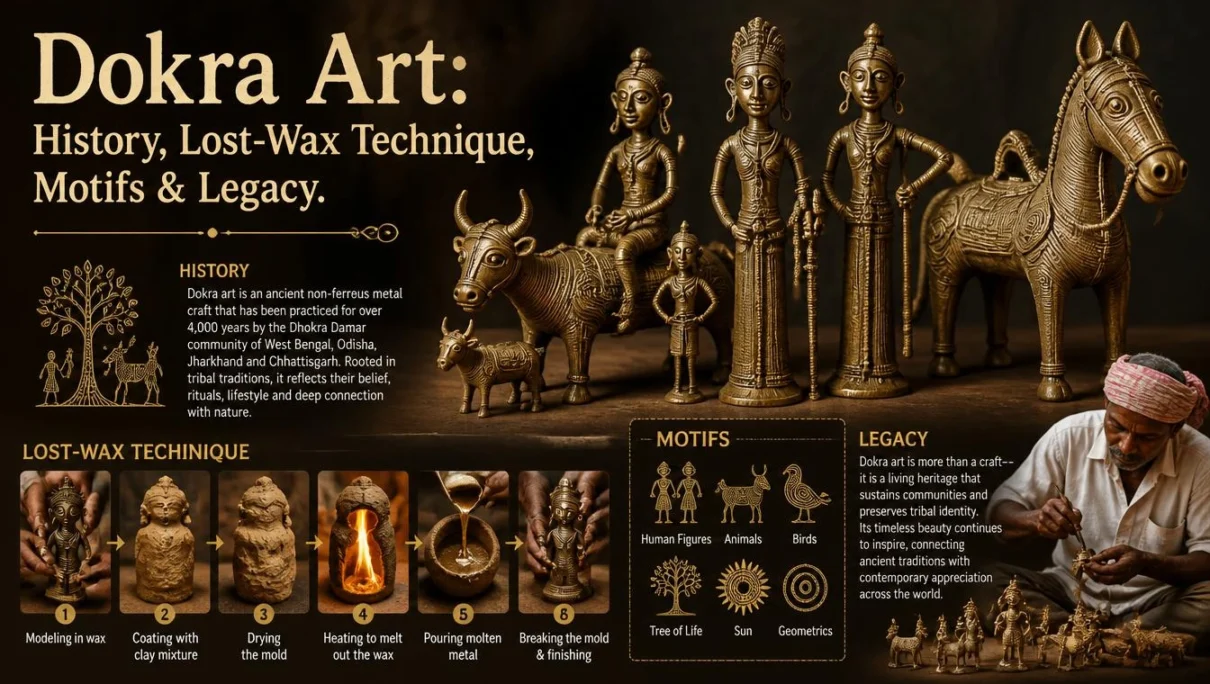
If someone asks what is lost wax casting technique, the basic principle can be explained quite simply: an artisan creates the desired form in wax, surrounds that form with a mold, melts the wax away, and fills the empty space with molten metal.
The simplicity of that explanation hides how demanding the actual craft can be.
The West Bengal government’s One District One Product documentation describes Bankura Dokra as an ancient lost-wax metal-casting tradition and refers to a distinctive 13-stage production process. The exact materials and individual procedures can vary between craft communities, but the traditional process broadly follows a recognizable sequence.
Building the Basic Form
The work normally begins with a clay core that establishes the basic volume of the sculpture. At this point, an elephant may look like little more than a rough mass with four legs and a trunk. A human figure is similarly reduced to its basic structure.
Wax is then prepared until it can be rolled, stretched and modeled. The artisan covers or builds upon the clay core with wax, gradually creating the actual surface that will later appear in metal. This is where many of the characteristic lines, coils, jewelry details, facial features and geometric patterns of Dokra Art are created.
Those beautiful thread-like decorations seen on finished Dokra sculptures are therefore not simply engraved into the metal afterward. Much of that visual information has already been worked out during the wax-modeling stage.
From Wax to an Empty Mold
Once the wax model is complete, the artisan adds channels through which metal can later flow and gases can escape. The entire object is then covered with layers of prepared clay to create a strong outer mold.
The mold is heated, and something fascinating happens: the wax that carried all those carefully created details melts and leaves the mold. The original wax sculpture effectively disappears.
Only its negative impression remains inside the clay.
That is why the process is called “lost wax.”
Replacing Wax With Metal
Molten metal is poured into the space that the wax occupied. Once it cools and solidifies, the outer clay mold is broken away.
For the first time, the artisan sees the metal version of the sculpture.
The object then requires cleaning and finishing. Unwanted casting channels may be removed, rough areas corrected, surfaces polished and details refined. The result retains the character of the wax model but now exists permanently in metal.
This sacrificial process also explains why handmade Dokra naturally resists perfect industrial repetition. The wax model disappears and the mold is broken. To make another piece traditionally, much of the process must begin again.
What Metal Is Used in Dokra Art?
Dokra is generally associated with non-ferrous metal casting, particularly brass and related alloys. West Bengal’s documentation of Bankura Dokra refers to the use of metals including brass along with other alloying materials.
The exact composition can differ depending on the artisan, region, available materials and intended object. This partly explains why Dokra pieces do not all have exactly the same color. Some have a warm golden tone, while others appear darker brown or acquire a deep aged patina.
For the artisan, metal is not merely the substance used to preserve a design. Its color, weight, surface and reaction to heat all contribute to the finished work.
Dokra Art Motifs and Symbols: Stories Hidden in Metal
Spend time looking at Dokra rather than simply glancing at it, and another dimension begins to appear. Many dokra art motifs and symbols originate in the natural, social and spiritual worlds surrounding the communities that make them.
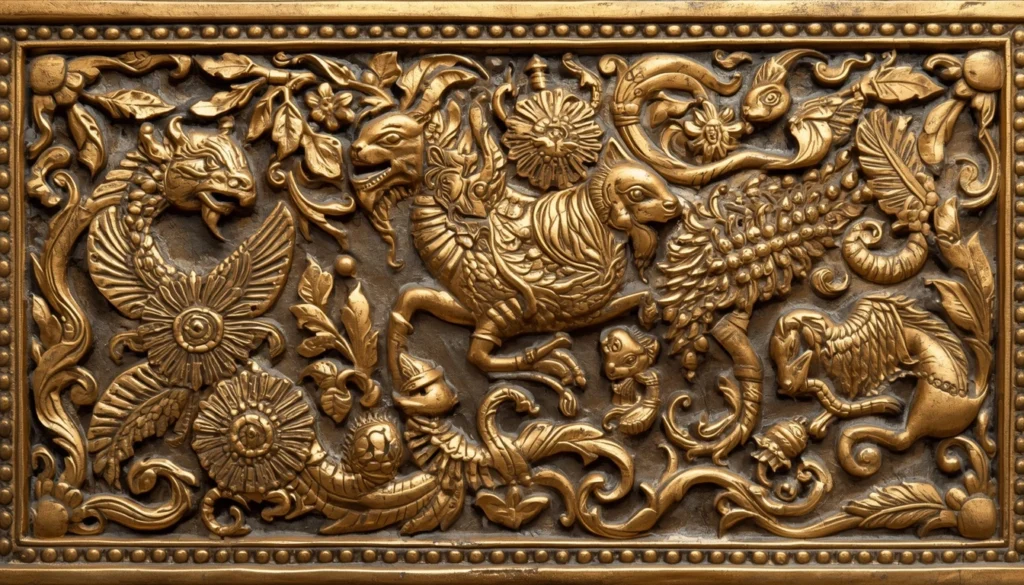
Animals are especially common. Elephants, horses, bulls, birds, fish and turtles appear alongside human figures, musicians, dancers, mothers with children, deities and scenes inspired by everyday life. Plants, trees and geometric forms may become part of the composition as well.
It is tempting to assign a fixed symbolic meaning to every animal, but that can oversimplify the tradition. An elephant may suggest strength, prosperity or ceremonial importance depending on context, while a horse can carry associations with movement, power or status. The meaning of an object should therefore be understood in relation to its maker, region and intended use rather than through a universal online “symbol dictionary.”
Human life is equally important. Musicians play instruments, women carry vessels, figures dance, families interact and people appear engaged in ordinary activity. Through such objects, Dokra sometimes becomes a miniature visual record of the society around the artisan.
Then there is the geometry. Repeated coils, spirals, lines, lattices, triangles and bands create rhythm across the surface. Even a relatively simple animal can become visually complex because of this repeated ornamentation. In that sense, Dokra’s surface is almost like drawing with wax before the drawing is transformed into metal.
Dokra Art Bankura West Bengal: A Living Tradition
For anyone researching dokra art bankura west bengal, Bankura is one of the most important places to understand. The craft is particularly associated with artisan communities in and around Bikna, while another important Bengal Dokra community exists at Dariyapur in the Bardhaman region.
The Government of West Bengal’s ODOP documentation identifies Bankura Dokra as a GI-recognized craft and reports that approximately 350 artisans are engaged in its production. India’s official Geographical Indications registry lists Bengal Dokra as a registered handicraft, with registration dated August 17, 2016.
These details matter because Dokra is sometimes presented as though it belongs mainly inside museums or craft-history books. It does not. For hundreds of artisans and their families, it remains connected with livelihood, community knowledge and everyday economic survival.
Many Bengal Dokra works are immediately attractive because of their strong linear treatment. Human and animal forms may be elongated or stylized, while the surfaces are covered with intricate coils and repeated patterns. Traditional subjects remain important, but contemporary makers increasingly create products for modern homes and urban consumers.
That change should not automatically be viewed as a loss of tradition. A craft that has survived for generations has already survived because people adapted it to new circumstances.
Dhokra Art Odisha: Shared Technique, Regional Identity
Odisha is another important center of India’s lost-wax metal tradition. Official Odisha Tourism documentation includes Dhokra casting among the state’s significant traditional crafts. Sadeibereni near Dhenkanal is particularly associated with dhokra art Odisha, and Odisha Tourism documents it as a craft village where artisans continue to produce metal objects using the lost-wax process.
The existence of strong traditions in both Bengal and Odisha raises an important point. We should resist putting every Dokra object into a generic “Indian tribal art” category. Two communities may share the same fundamental casting technology while developing different proportions, motifs, surface treatments and aesthetic preferences.
The interesting question is therefore not whether Bengal Dokra or Odisha Dhokra is superior. It is how different communities took the same remarkable technological idea—replacing wax with molten metal—and made it culturally their own.
Dokra Art vs Warli Art Comparison
A dokra art vs warli art comparison also shows why broad categories such as “folk art” or “tribal art” need to be used carefully. Dokra and Warli may both be discussed within Indian traditional art, but their materials and creative processes are fundamentally different.
| Feature | Dokra Art | Warli Art |
| Main medium | Metal | Traditionally wall/painted surface |
| Technique | Lost-wax casting | Painting/drawing |
| Form | Mainly three-dimensional | Mainly two-dimensional |
| Visual character | Textured, modeled metal forms | Geometric figures and linear compositions |
| Typical themes | Humans, animals, deities, rituals, everyday life | Community, farming, nature, rituals, celebrations |
| Making process | Modeling, molding, firing, casting and finishing | Drawing and painting |
| Common modern forms | Sculpture, jewelry, décor, utility objects | Paintings, prints, textiles and design applications |
The difference is almost philosophical. Warli generally builds its visual world through line and shape on a surface. Dokra builds through mass, volume, texture and metal.
Calling both simply “tribal art” tells us very little about either.
Why Two Handmade Dokra Pieces Are Never Quite the Same?
Imagine a factory producing ten thousand identical decorative elephants. Once the industrial mold is perfected, repetition is the objective.
Traditional Dokra works differently.
The wax surface is shaped by hand, the ornamentation is applied individually, molten metal behaves slightly differently during each casting, and the sacrificial mold has to be broken to reveal the sculpture. Even if an artisan repeatedly makes the same popular design, small variations appear in the proportions, surface patterns, facial expression, metal flow and final finishing.
This gives us a useful way to understand the value of handmade Dokra: you are not merely buying a design; you are buying the result of an individual act of making.
Is Every Brass Sculpture Dokra?
No, and this is especially important for buyers.
An object does not become Dokra simply because it is made from brass, has a rustic finish or is marketed online as “tribal metal art.” The identity of Dokra is closely connected with its lost-wax production method and the craft traditions within which that process is practiced.
If authenticity matters to you, ask practical questions. Where was the object made? Who made it? Was it produced using lost-wax casting? Does the seller know the artisan, cooperative or craft cluster? Is the piece genuinely handmade or a mechanically reproduced object designed to imitate the Dokra aesthetic?
Provenance usually tells you more than appearance alone.
How to Identify Handmade Dokra Art
Authenticating a craft object from appearance alone is difficult, particularly when buying online. Still, handmade pieces often reveal subtle clues. Decorative lines may vary slightly in thickness. The two sides of a figure may not be perfectly symmetrical. The surface can contain small irregularities that reflect wax modeling and casting rather than machine finishing.
But irregularity itself does not prove authenticity. Manufacturers can imitate a handmade appearance.
The strongest evidence remains knowing who made the piece and where it came from. Buying directly from artisans, recognized cooperatives, established craft organizations or sellers who provide meaningful provenance reduces uncertainty considerably.
Dokra Art Contemporary Relevance: Can an Ancient Craft Stay Modern?
The question of dokra art contemporary relevance becomes particularly interesting today. We live in a world filled with objects designed for perfect repetition. Industrial production can manufacture identical products by the thousands, while digital technology can reproduce an image infinitely without changing it.
Dokra offers almost the opposite experience. Its attraction lies partly in texture, individuality and evidence of human labor.
That does not mean contemporary Dokra should remain restricted to traditional elephants, horses and ritual figures. Artisans and designers are already exploring jewelry, lighting, contemporary sculpture, tableware, corporate gifts, architectural accents and interior objects. The visual language can evolve while the knowledge of lost-wax casting continues.
This is where discussions about “preserving tradition” sometimes become problematic. If preservation means asking artisans to repeat exactly the same objects forever because tourists expect them, the tradition can become frozen. A living craft should have room for experimentation.
Tradition and innovation are not necessarily enemies. The inherited knowledge may remain in the manipulation of wax, preparation of the mold, control of heat and casting of metal, while the artist develops completely new subjects and forms.
The Economic Side of Preserving Dokra
There is also a practical reality behind every discussion about cultural preservation: artisans need to earn a sustainable living.
West Bengal’s ODOP documentation reports approximately 350 artisans associated with Bankura Dokra, while state MSME records also document individual Dokra craft units associated with the Dariyapur artisan community.
When a younger member of an artisan family decides that another occupation offers a more secure future, the craft does not simply lose one worker. It can lose knowledge that may have been transmitted through observation and practice rather than textbooks.
An experienced artisan may judge wax consistency by touch, clay preparation through familiarity, or casting conditions through years of trial and error. Such knowledge is difficult to recover once the chain of transmission is broken.
Preserving Dokra therefore requires more than exhibitions celebrating India’s heritage. It requires markets, fair remuneration, design development, visibility and opportunities that make remaining in the craft economically worthwhile.
Why Dokra Art May Matter Even More in the Age of AI
There is an interesting paradox here.
As technology becomes increasingly capable of producing flawless images and standardized objects, evidence of the human hand may become more valuable rather than less.
AI can generate hundreds of visual variations in seconds. Digital files can be duplicated perfectly. Industrial production can make identical objects at enormous scale. A handmade Dokra sculpture carries a completely different kind of information.
A slightly uneven wax line tells us someone physically made it. A casting mark records what happened when molten metal entered a particular mold. A subtle difference between two elephants tells us that the second was not simply copied from the first with mathematical precision.
Its imperfection becomes a record of its creation.
Perhaps this is one reason an ancient craft can remain meaningful in a technological age. Dokra does not have to compete with machines at producing perfect repetition. Its value lies precisely where machines are strongest at eliminating variation.
Frequently Asked Questions about Dokra Art
What is Dokra Art?
Dokra Art is a traditional Indian metal craft made principally through the lost-wax casting process. A wax model is created around a core, enclosed in a clay mold, melted away and replaced with molten metal.
Is it Dokra or Dhokra?
Both Dokra and Dhokra are accepted and commonly encountered spellings. Different regional, governmental and cultural sources use both forms.
What is lost wax casting technique?
The lost wax casting technique involves making a form in wax, creating a heat-resistant mold around it, melting the wax out and pouring molten metal into the cavity. After cooling, the mold is broken to reveal the casting.
Where is Dokra Art famous in India?
Important Dokra and Dhokra traditions exist across eastern and central India. Bankura and Dariyapur are significant centers in West Bengal, while Odisha has important Dhokra communities including Sadeibereni near Dhenkanal.
Is Bengal Dokra GI registered?
Yes. India’s official GI registry records Bengal Dokra as a registered handicraft, with registration dated August 17, 2016.
Why is authentic Dokra Art expensive?
The price reflects far more than the metal itself. Traditional Dokra requires clay preparation, core construction, detailed wax modeling, mold making, heating, metal casting, breaking the mold, cleaning and finishing. Larger and more intricate works require considerable time and skill.
What are common dokra art motifs and symbols?
Common subjects include elephants, horses, birds, fish, human figures, musicians, dancers, deities, mother-and-child forms and scenes from everyday life. Geometric coils, lines and repeated surface patterns are also characteristic of many traditions.
What is special about dokra art Bankura West Bengal?
Bankura is one of Bengal’s major Dokra centers. West Bengal’s official ODOP documentation identifies the craft as GI registered and reports approximately 350 artisans involved in its production.
What is special about dhokra art Odisha?
Odisha maintains important Dhokra metal-casting traditions. Sadeibereni near Dhenkanal is one documented craft center where artisans continue working with the lost-wax process.
How is Dokra different from Warli art?
Dokra is principally a three-dimensional metal-casting tradition, whereas Warli is fundamentally a two-dimensional painting tradition. They differ in material, technique and visual construction even though both are often discussed under the broad umbrella of Indian traditional art.
Dokra Art Is More Than an Ancient Craft
The easiest way to describe Dokra Art is to call it an ancient Indian metal craft. That description is correct, but incomplete.
Look more closely and a Dokra sculpture becomes a record of knowledge. Someone had to understand how to build the clay core, manipulate wax, construct a mold, control heat, pour metal and finish the resulting form. At the same time, someone had to decide what the figure should look like, how its body should be proportioned, where a decorative line should travel and what expression or movement the sculpture should communicate.
That is where engineering and imagination meet.
From dokra art bankura west bengal to dhokra art odisha, the craft continues because artisans are still practicing, adapting and transmitting this knowledge. Bengal Dokra’s GI recognition provides formal acknowledgement of that cultural identity, but a GI registration alone cannot keep a tradition alive.
People have to continue making it. Younger generations need a reason to learn it. Buyers need to understand what they are purchasing. Designers need to see possibilities beyond repetitive souvenir forms. And artisans themselves need the freedom to experiment.
Perhaps the best way to preserve Dokra Art is therefore not to ask it to remain exactly as it was.
It is to make sure the knowledge survives long enough for the next generation of artisans to decide what it can become.
The future of Dokra Art will depend on more than preserving old forms. It will depend on whether artisans can continue earning from the craft, whether younger generations see value in learning it, and whether contemporary designers and buyers understand the depth of the process behind each object. If that knowledge continues to evolve rather than being frozen into repetition, Dokra Art can remain not simply a reminder of India’s past, but a living and relevant artistic practice for the future.