
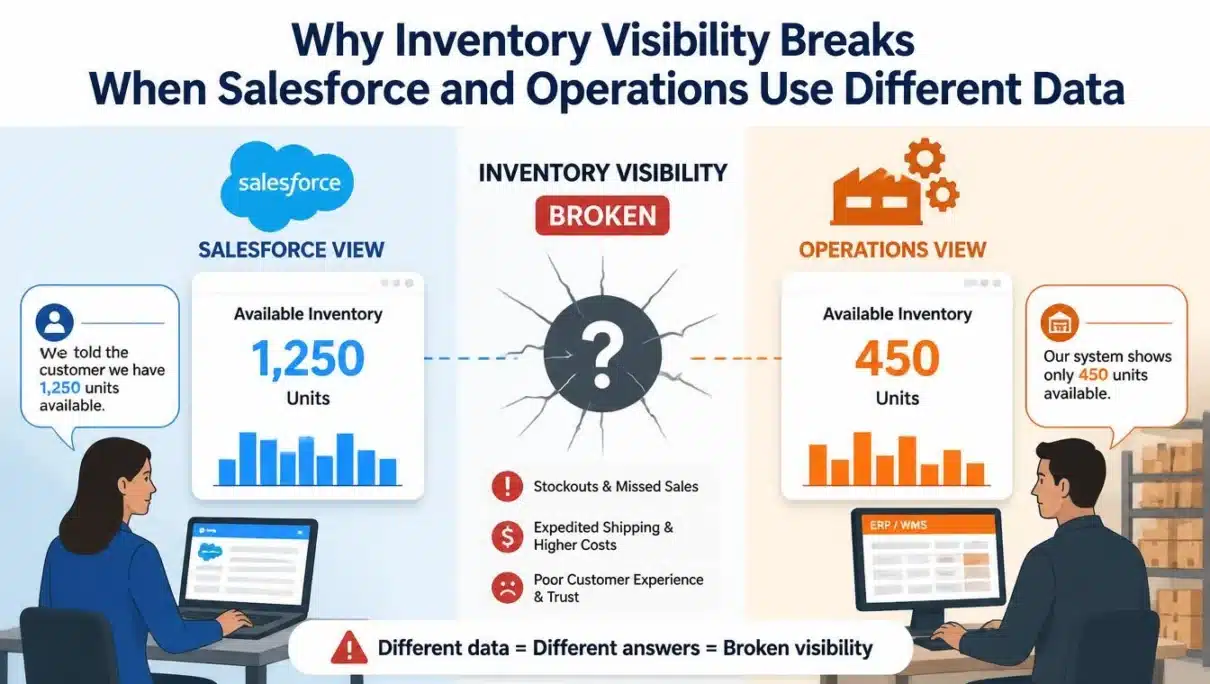
Many companies believe they have an inventory accuracy problem.
The warehouse count does not match the system. Sales promises products that are unavailable. Purchasing orders too much of one item and too little of another. Field technicians arrive without the right parts. Customer service cannot explain when an order will ship.
These look like separate operational failures.
In many cases, they have the same cause: inventory information is separated from the business processes that create demand, move stock and commit products to customers.
The company may use Salesforce for customers and sales orders, spreadsheets for purchasing, a warehouse system for stock, a shipping application for despatch and an accounting package for valuation.
Every application may contain valid information. But no team sees the complete operational picture.
Inventory is not just a quantity
Inventory management is often reduced to one question:
How many units are in stock?
That number matters, but it is not enough to make a reliable decision.
Sales needs to know how many units can be promised.
Purchasing needs to know how much demand is expected.
Production needs to know whether components are available.
The warehouse needs to know where items are stored.
Quality needs to know whether stock can be released.
Finance needs to know what the stock is worth.
A complete inventory view may need to include:
- Quantity on hand
- Quantity available
- Allocated quantity
- Reserved quantity
- Expected receipts
- Warehouse and bin location
- Lot or batch number
- Serial number
- Expiry date
- Quality status
- Unit cost
- Customer or work-order demand
- Stock in transit
When these values are managed separately, teams can look at the same product and reach different conclusions.
How disconnected inventory creates customer problems
Suppose a customer asks whether 100 units can be delivered next Friday.
Salesforce may show that the product exists. The inventory system may show 150 units on hand.
But 80 units are allocated to another order, 30 are on quality hold and 20 are stored at a location that cannot meet the delivery date.
Only 20 units are genuinely available.
If Salesforce receives only a periodic total from the inventory system, sales may confirm an order the business cannot fulfil.
The problem is not that Salesforce lacks a number. The problem is that the number lacks operational context.
Inventory accuracy depends on process discipline
Technology cannot maintain accurate inventory if physical movements are not recorded correctly.
Every stock event should create a controlled transaction, including:
- Supplier receipt
- Put-away
- Bin transfer
- Material issue
- Production consumption
- Finished-goods receipt
- Customer allocation
- Pick and pack
- Shipment
- Customer return
- Supplier return
- Stock adjustment
- Cycle count
- Inter-warehouse transfer
When employees update spreadsheets later or rely on memory, system stock gradually separates from physical stock.
Barcode scanning can reduce manual entry, but the process behind the scan still matters. The system must know what is moving, from where, to where, in what quantity and for which order or work instruction.
Sales should see available-to-promise inventory
Sales teams should not need to phone the warehouse before confirming every order.
They need access to an inventory view that reflects operational commitments.
Available-to-promise calculations may consider:
- Current available stock
- Existing sales allocations
- Open production orders
- Expected purchase receipts
- Supplier dates
- Transfer orders
- Quality restrictions
- Customer priorities
This does not mean every salesperson should have permission to override allocation rules.
It means they should make commitments using the same underlying information as operations.
Purchasing needs demand context
Purchasing decisions become unreliable when buyers see stock balances without understanding future demand.
A product may appear overstocked based on current usage but be required for a confirmed production order next month.
Another item may appear low but have a large supplier delivery arriving tomorrow.
Good inventory management connects purchasing with:
- Sales orders
- Forecasts
- Work orders
- Bills of materials
- Reorder policies
- Supplier lead times
- Open purchase orders
- Safety stock
- Warehouse demand
This helps buyers distinguish between a genuine shortage and a temporary low balance that is already covered.
Manufacturing needs traceable material movement
For manufacturers, inventory accuracy directly affects production.
If component quantities are wrong, MRP recommendations become unreliable. Work orders are released without the required material. Purchasing expedites items the company already owns, while genuine shortages remain hidden.
Manufacturers may also need traceability across:
- Raw-material lots
- Serialised components
- Production batches
- Scrap and rework
- Finished goods
- Customer shipments
- Returns and recalls
Traceability should not begin with a spreadsheet assembled during an audit. It should be created through ordinary receiving, production and shipping activity.
Field service inventory should not be forgotten
Inventory may exist beyond the main warehouse.
Field-service organisations often hold stock in:
- Technician vehicles
- Regional depots
- Customer sites
- Repair centres
- Consignment locations
A part used during a service visit should update the relevant stock location and connect to the work order, customer asset and service cost.
Without that connection, the company cannot reliably replenish van stock, calculate service profitability or determine which parts were installed on a customer asset.
Why inventory management belongs close to Salesforce
Salesforce already contains important demand and customer context:
- Accounts
- Opportunities
- Quotes
- Sales orders
- Service cases
- Field-service work
- Customer assets
- Delivery commitments
When inventory is held in a separate ERP or warehouse system, this information must cross an integration before Salesforce users can act on it.
The integration may work correctly and still introduce limitations. Updates may be scheduled rather than immediate. Only selected fields may be synchronised. Allocation and quality context may remain in the operational system. Users may need to switch applications to understand exceptions.
With Salesforce inventory management, stock records can remain connected to the customer, order, purchasing, manufacturing, warehouse and service processes that use them.
The objective is not to place another stock figure on an account page. It is to allow commercial and operational teams to work from the same inventory transactions and rules.
What buyers should look for
Companies evaluating inventory software on Salesforce should consider the entire operational process.
Multi-location control
Can the system manage warehouses, bins, vehicles, customer locations and stock in transit?
Allocation
Can inventory be allocated to customer orders, work orders or service requirements without losing visibility?
Lot and serial tracking
Can the company trace materials from receipt through production, shipment and return?
Receiving and put-away
Can warehouse teams record supplier receipts, discrepancies, quality status and storage locations?
Replenishment
Can the system use demand, reorder points, safety stock and supplier lead times to support purchasing?
Barcode processes
Can users scan receipts, transfers, picks, counts and shipments using practical warehouse workflows?
Manufacturing connection
Does material consumption update stock and support BOM, work-order and MRP processes?
Shipping connection
Can picked inventory flow into packing, carrier booking, tracking and shipment confirmation?
Financial visibility
Can finance understand inventory cost, movement and valuation without manually reconciling multiple systems?
Questions to ask during a product demonstration
A meaningful inventory demonstration should show more than a stock dashboard.
Ask the vendor to demonstrate:
- Receiving a purchase order
- Recording a short or damaged delivery
- Putting stock into a warehouse bin
- Allocating inventory to a sales order
- Transferring stock between locations
- Issuing components to a work order
- Tracking a lot or serial number
- Completing a cycle count
- Picking, packing and shipping an order
- Processing a customer return
This reveals whether the software supports real operational transactions or mainly provides reporting.
One inventory record should support every team
Inventory cannot be managed effectively as an isolated warehouse function.
Every sales commitment, purchase order, work order, service visit, shipment and return can change what stock is available and what the business should do next.
When those processes share one operational data model, sales can make better promises, purchasing can act on real demand, manufacturing can plan with greater confidence, and warehouses can execute without constant reconciliation.
The result is not merely a more accurate stock count. It is a business that can respond to customers using information that reflects what is actually happening.