
To speak of the best drawing for indranilbanerjee.co.in art section is not merely to select an accomplished sketch from among many studies. It is to identify a work that most fully embodies the restless intelligence of Indranil Banerjee’s draughtsmanship: its instinctive lines, its layered ambiguities, its refusal to settle into a single image, and its capacity to remain alive under repeated viewing. These two drawings, though different in emotional weather and structural rhythm, reveal something fundamental about the artist’s visual mind. They are not casual notebook exercises. They are sites of search, pressure, memory, and revelation.
Best Drawing for Indranilbanerjee.co.in Art Section as a Critical Standard
When a critic looks for the best drawing for indranilbanerjee.co.in art section, the question is not, “Which one is prettiest?” It is, rather, “Which drawing holds the greatest density of transformation?” A strong drawing does not simply illustrate an idea. It generates one. It permits forms to emerge, dissolve, collide, and return in altered states. Banerjee’s language has always lived close to this edge—between recognition and uncertainty, between the remembered object and the unstable image. In that sense, these drawings should be understood not as preparatory works alone, but as primary acts of thinking.
Drawing, in serious artistic practice, is often the most honest medium. Painting can seduce. Color can distract. Surface can flatter. But drawing exposes the artist’s internal mechanics. It records hesitation, revision, aggression, doubt, acceleration, and conviction. In these works, one sees exactly that: not polished certainty, but a mind discovering form while simultaneously resisting closure.
Best Drawing for Indranilbanerjee.co.in Art Section: The First Drawing and Its Internal Drama
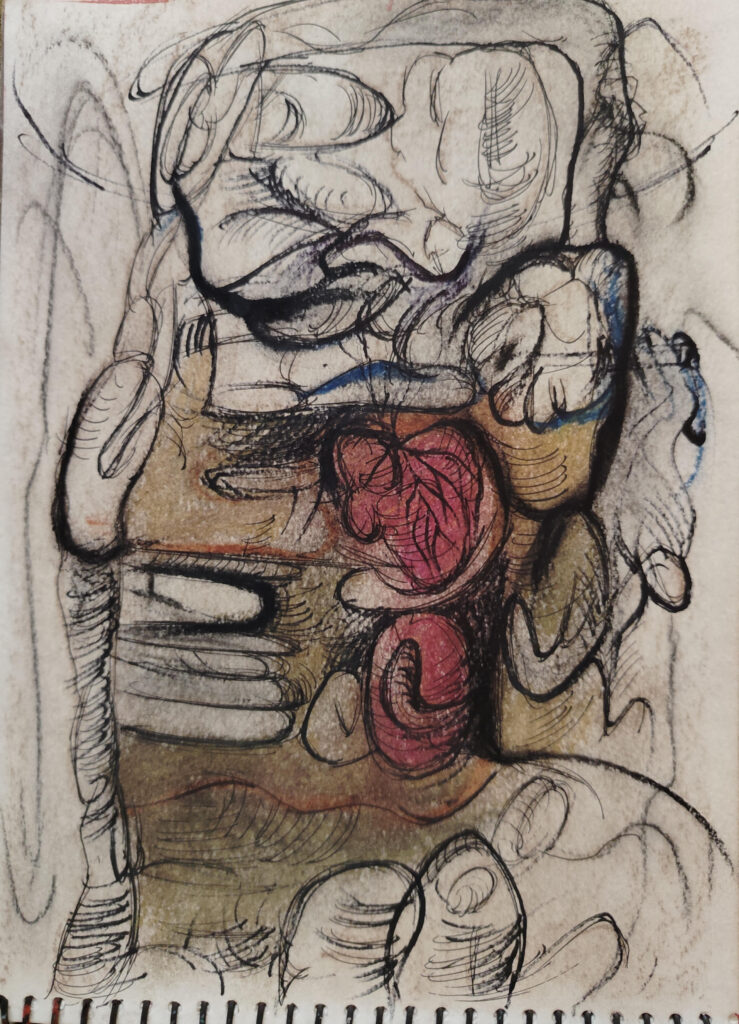
The first image is immediately arresting for its compression of forms. The composition rises vertically like a dense psychological column. One does not “read” it from top to bottom in a linear manner; one enters it, almost as one enters a dream already in progress. There are swollen anatomical suggestions, folded shapes, tubular extensions, and central red forms that behave almost like exposed organs, or perhaps symbolic seeds, or perhaps emotional condensations. Banerjee wisely leaves such identifications unstable.
What is remarkable here is the relationship between line and containment. The darker contour lines do not merely describe shapes; they impose pressure upon them. These boundaries seem to struggle against the inner movement of the forms they hold. The drawing appears to have been built through successive recognitions: a shape begins as one thing, then mutates into another, then is interrupted by a competing structure. This is the hallmark of mature drawing. It is not designed to be instantly legible. It compels the viewer to remain with it.
The muted earth tones, interrupted by those concentrated reds and occasional blue accents, intensify this effect. They do not function decoratively. Rather, they establish zones of emotional temperature. The reddish elements feel visceral, as though they belong to an interior life breaking through the restraint of the composition. Around them, the beige and grey fields create a skin-like atmosphere—something between body, wall, memory, and sediment. This instability is one of the strongest reasons the work may be considered a candidate for the best drawing for indranilbanerjee.co.in art section.
Best Drawing for Indranilbanerjee.co.in Art Section and the Question of Recognition
One of Banerjee’s enduring strengths is that he never abandons the viewer entirely. Even in his most abstract or fractured works, there is always a threshold of recognition. Here, one senses the possibility of a figure, or several figures fused; one senses a torso, perhaps, or a stacked organism, or a ritual object transformed by psychic pressure. Yet each time the eye tries to stabilize the image, another form interrupts. This is not confusion for its own sake. It is a sophisticated visual strategy.
The drawing therefore behaves differently depending on distance. From afar, it appears almost sculptural. Closer in, it becomes calligraphic. Closer still, it is anatomical, then architectural, then purely gestural. This mutability is central to Banerjee’s art. It is also what distinguishes a memorable drawing from an illustrative one. The latter tells you what it is. The former keeps becoming.
Best Drawing for Indranilbanerjee.co.in Art Section: The Second Drawing and the Theatre of Memory
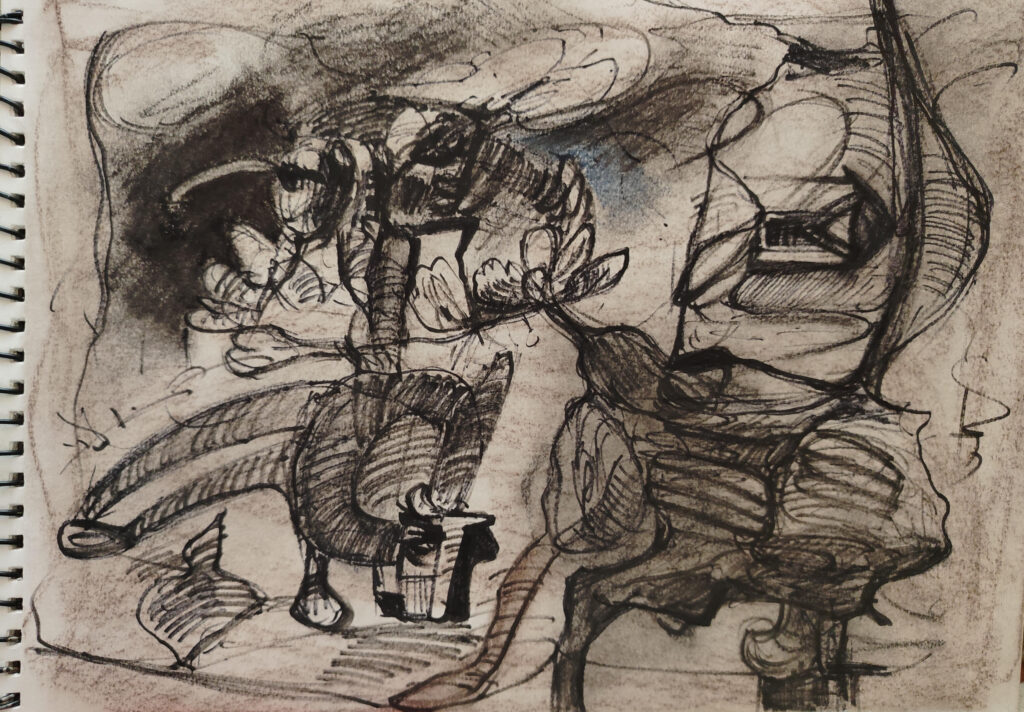
The second drawing moves in another direction. If the first is vertically compressed and inward, the second is more atmospheric and dramatic. The tonal field is darker, more charred, more nocturnal. One immediately senses the presence of environment—storm, smoke, memory, shadow. Within this field, forms begin to cohere: an elephant-like head or trunked presence, architectural fragments, vegetal shapes, perhaps a shrine-like structure, perhaps an object of ritual or burden. But again, Banerjee resists simple naming.
This drawing is especially compelling because of its theatrical staging. The dark clouding at the upper left establishes a psychological sky under which the image unfolds. The forms do not sit calmly in space; they seem summoned from it. The central creature-like structure—if creature it is—carries both dignity and instability. It appears ancient and contemporary at once, mythic and broken. On the right, the architectural geometry introduces another register: civilization, shelter, ruin, construction. Between these zones, the drawing oscillates between memory-image and invented form.
As a critic, one notices the confidence of the charcoal handling. The darker passages are not timid. They do not merely shade. They excavate. Banerjee uses tonal mass to counterbalance the nervous energy of line. This gives the drawing depth and gravity. It does not feel like a sketch drifting toward an idea; it feels like an image already carrying historical and emotional weight.
Best Drawing for Indranilbanerjee.co.in Art Section in Relation to International Drawing Practice
To understand why these works matter, one must place them in a broader lineage of modern and contemporary drawing. Important artists have often used drawing not to clarify the world but to reveal its instability. From the psychologically charged distortions of postwar figuration to the hybrid symbolic spaces of late modernist draftsmanship, drawing has served as the most immediate theatre of transformation. Banerjee’s works stand meaningfully within that tradition.
What is particularly distinctive in his case is the fusion of instinctive mark-making with a layered visual intelligence rooted in memory, body, folk suggestion, and symbolic mutation. There is nothing merely derivative here. If echoes appear, they do so because all serious drawing belongs to a conversation across time. But Banerjee’s line has its own accent: searching, recursive, elastic, and at moments almost tactile. It circles, presses, scratches, returns, overlays. It does not perform refinement; it performs encounter.
Best Drawing for Indranilbanerjee.co.in Art Section and the Viewer’s Experience
A great drawing is not exhausted by one glance. It stays with the viewer because it continues to rearrange itself after viewing. These two works possess that afterlife. The first lingers as a compact internal pressure, almost bodily in its effect. The second lingers as an environment of memory and disturbance. Both reward slowness. Both reject the quick consumption that contemporary image culture often encourages.
That is why they are especially important for a digital art section. Online, drawings are frequently reduced to thumbnails, fragments, or passing posts. But Banerjee’s works insist on another form of attention. They ask to be revisited on screen, enlarged, reconsidered, and, ideally, seen in person. They create an encounter rather than a mere impression.
Best Drawing for Indranilbanerjee.co.in Art Section: Final Critical View
If one must choose the best drawing for indranilbanerjee.co.in art section, the decision finally depends on what one values most in Banerjee’s practice. The first drawing may be judged superior for its extraordinary internal density and visceral compositional intelligence. The second may be preferred for its atmospheric depth, mythic ambiguity, and tonal command. Together, however, they reveal the larger truth: Indranil Banerjee’s drawing practice is not secondary to his painting. It is one of the deepest sources of his artistic authority.
In these sheets, one sees an artist not decorating paper but testing perception itself. The line searches; the form resists; the image shifts. That is the true measure of the best drawing for indranilbanerjee.co.in art section: not that it provides a final answer, but that it keeps the act of seeing alive.
About the Critic D. Sumita
D. Sumita is an independent art critic and writer known for her perceptive readings of contemporary visual practice, particularly in drawing and abstract figuration. With a keen interest in the psychology of form and the evolving language of line, her writing bridges intuitive response and critical analysis. Over the years, she has contributed essays, reviews, and curatorial texts that foreground emerging and under-recognized artists, bringing attention to practices that challenge conventional aesthetics. Her approach is marked by clarity, depth, and a sensitivity to the layered narratives embedded within visual art.