From the television of your youth to Oscar-nominated films to the small screen at 1 AM, animation is in everything you do and see. But the thing that we never acknowledge is that animation is more than just entertainment. It embodies ideas, ideologies, fears, and worldviews. Every single frame produced by a studio is, in its own way, a cultural artifact.
From American early hand-drawn shorts to the complex, folktale-based animation of Japan, Malaysia, and India, animation has never been about more than just making people laugh or cry. It tells young children what constitutes beauty. It tells people who deserve to have their story told. It increasingly tells us what kinds of cultures deserve to be recognized.
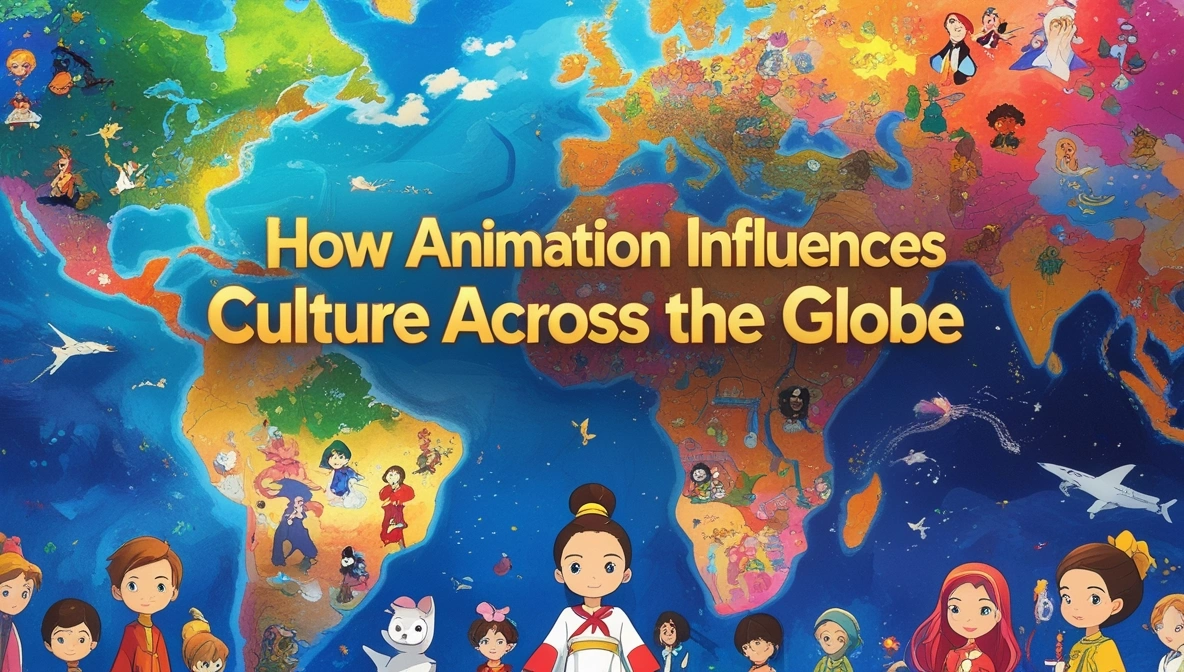
This blog takes a look at the way animation, rather than reflecting culture, actively constructs it in cultures around the globe.
The West wrote the default- whether they meant to or not
For most of the 20th century, most of the world’s audience knew one type of animation, American. Disney, Warner Bros., MGM – it was more than just cartoons; they developed a language of the visual that the world would absorb as the default. Disney’s films, in particular, had an unparalleled influence:
- Fairy tales derived from European folklore were retold as stories of American can-do attitude and a clear moral structure – good prevails, evil is vanquished, virtue and beauty triumph
- Female protagonists in animation through the years followed certain rules of femininity
- The villains had been designed according to stereotypes that were heavily based on race and ethnicity, a fact explored in extensive detail by academics
Japan Revolutionised the Form.
By the time anime began to appear outside Japan in the eighties and nineties, there was a new vocabulary in animation. It was not the same visual language that Disney and Western animation were using.
There is no guarantee of a happy ending.
- The characters do not follow a black and white moral path – there are heroes who fail, villains with just cause, and villains who are simply evil.
- Death and sacrifice are not covered over in sensitive ears and eyes.
- Aesthetics are derived from traditional Japanese art – flat backgrounds, extreme eyes, sharp, clean lines.
- Studio Ghibli, in particular, displayed the cultural content that animation films could encompass. My Neighbour Totoro is imbued with Shintoist ideas about nature spirits, and Princess Mononoke tackles Japan’s conflicted relationship with industrialisation. They were not culturally “neutral” films; they were Japanese, which was why the audience flocked to them.
- Another assumption that this form of animation has challenged is that animation is only for children. Animation in Japan includes dramas, comedies, thrillers, work-based satires, and so much more.
South East Asia: Taking back storytelling, one cartoon at a time.
The most intriguing and most recently developing part of the global animation scene is probably occurring now in Malaysia, Indonesia, and the surrounding areas. For years, the children there were raised on American and Japanese cartoons, and the production infrastructure barely existed at all locally. In other words, they were raised on heroes that do not look like you, have houses that do not look like your house, and stories that do not sound like your folklore.
The effects of all of this are what the researchers are calling “a corruption of the native view of his or her culture,” where they come to believe sophistication and quality are the visual representations found in the work from elsewhere, their own mythology, meanwhile, is overshadowed. And the reaction?
Malaysian television now draws on the stories in local folklore – traditional characters from the Malay, Chinese, Indian, and many others, who have very little awareness in young Malaysians. Indonesian animators are beginning to incorporate wayang and local mythology in an animated format.
These animations do more than simply represent a return to traditional narratives; they function to make certain that local identity isn’t simply digested by foreign productions. Of course, it’s a tough uphill battle when you’re up against Disney, Pixar, and a whole archive of anime. But as many of these studios have begun to contend, animation is the perfect medium to house local mythology.
How Animation Teaches Kids about how culture ‘looks’.
This is perhaps the most evident way animation affects culture, and how the world works in the earliest years of a child’s life.
Children’s animation consistently teaches:
- Family structures -who counts as family, what the dynamics between parent and child look like
- Gender roles – what it is that boys do, what girls like, who does the rescuing
- Moral structures – what is celebrated, what is reprimanded, why
- What ‘normal’ looks like – what are foods like, what are homes like, holidays, the color of a person’s skin, the names of characters.
When every show a child watches includes the same type of family, the same style of hero, then that is the new default. Animation does not need to explicitly teach any values to be effective-the values will be imparted through the constant reiteration.
This is the exact reason that representation controversies in children’s animation often are what they are. Moana, Coco, and Turning Red-all films created by big Hollywood companies, using the framework of cultural traditions to tell their story, without trying to generalize or simplify cultures. But the result wasn’t only brilliant narratives-it was children seeing themselves reflected on the screen as heroes for the first time.
East-West Tension: As Animation Crosses Cultural Borders
Animation that moves across cultures doesn’t always fit nicely. It’s one of the most intriguing tensions in the medium today. When American studios bring stories from other cultures to the screen, they have been wildly inconsistent:
- Mulan (1998) took on a Chinese legend but filtered it through Hollywood tropes to the point that many Chinese viewers considered the story simplistic.
- The live-action remake of the movie in 2020 made a great effort at inclusivity using Chinese writers, actors, and consultants; this approach however, had mixed reactions among both Chinese and Western viewers.
- Kubo and the Two Strings looked at the Japanese aesthetic while American artists created the film virtually entirely, thus creating an acceptable tension in whose stories can be told by whom.
The inverse has issues. Many Western anime distributed in countries like America would have some portions of the film cut or the story adjusted to seem more appropriate (names altered, plots modified, themes softened, etc.). Audiences who were shown the altered versions of the film were shown a wholly different cultural product from the original viewing. This tension seems to show that animation isn’t a blank container just shipped around; every instance of animation is, in fact, a negotiation of contexts.
Animation as cultural preservation.
Some of the most exciting work being produced in animation at the moment is not being produced at all by mainstream studios. Independent producers and state-funded productions are employing the medium solely to record and transmit cultures:
- Aboriginal communities in Australia and Canada have used animation shorts to record their languages, myths, and oral stories for younger members of the communities who have no other relationship with them.
- African production houses are making content in which stories and characters derived from local folklore and history replace foreign, imported content that now makes up almost all the children’s content produced for Africa.
- Regional production studios in India are producing material in local languages, drawing their storylines from regional, rather than pan-Indian, myths and legends.
The objective here is not commercial reward. The motivation is that when a story dies, the story has gone; and when a generation has grown up, with no experience of it, then it is hard to bring it back.
Conclusion
Animation has always been more than an aesthetic medium. It is a cultural technology, the kind that encodes values, transports identity, and tells collectives what stories are worth telling.
The most crucial change underway globally in animation is not a technical one. It’s not improved render speeds or increased runtime. It’s the increasingly powerful voice of non-Western producers insisting their stories, told in their own aesthetic grammars, can take their place not just adjacent to, but on the same level as the global traditions that have been established as norms for much of the last hundred years.
What you watch makes what you expect seem normal; what is made makes what you watch. Animation shapes culture, and culture shapes animation, and knowing this loop is the first step towards seeing clearly what the medium is up to.
FAQs
Q: What is animation’s relationship to cultural identity?
Animation displays the way stories, characters, and practices of life look for young children and adults – over time, this allows us to develop the concept of what is “real” or worth applauding.
Q: What is so significant about representation in animation?
Seeing your own background in animation shows that the stories from your culture are valuable. Continuously not seeing representation or seeing it distorted demonstrates the inverse of this.
Q: Is anime considered a cultural export?
Yes, anime is heavily discussed as one of the most successful cultural exports Japan has ever created, by taking Japanese customs, ideals, and issues across the board.
Q: Can animation be used as cultural conservation?
Yes, animation has been used by minority and indigenous groups in order to pass down myths, stories, and the use of languages that would otherwise disappear in time between generations.
Q: What is considered an inauthentic animated film?
Animation adapted to another culture will often become an inauthentic film because, while its appearance may appear correct in terms of costume, it will lack the original substance and story.