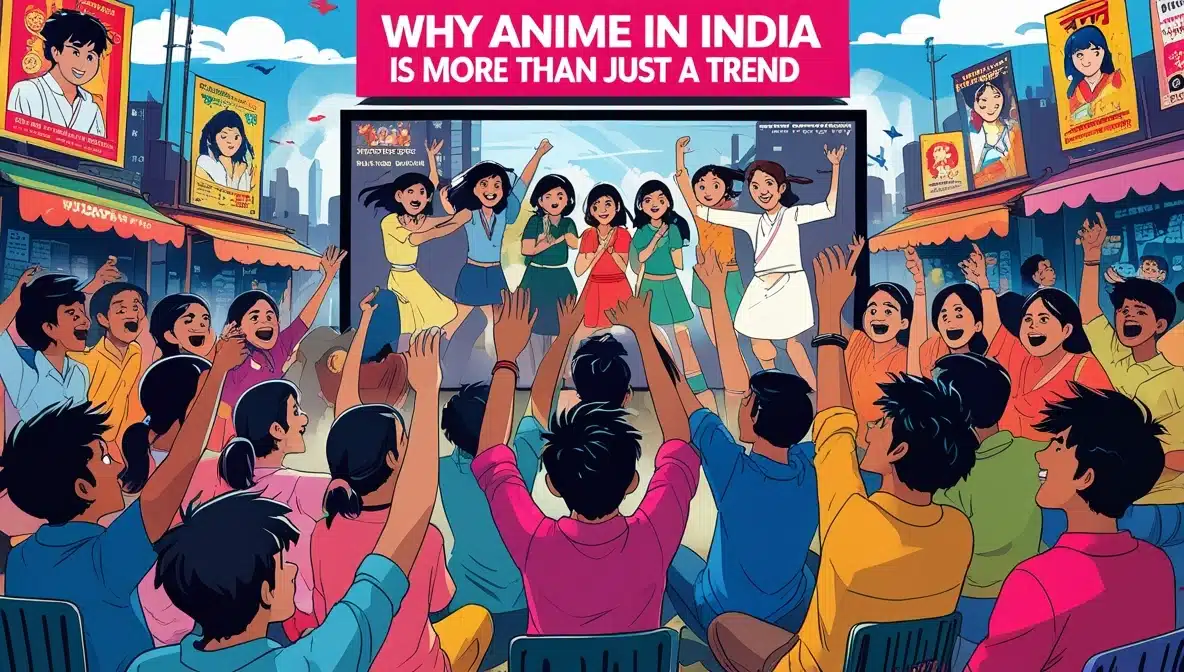
Why Anime in India Is More than Just a Trend
Anime in India has the world’s second-biggest anime market with an approximate 118 million active watchers, scattered across streaming platforms, YouTube, and even broadcast TV. That’s a lot to digest for a genre that, till recently, most people in the country thought of as just ‘cartoons from Japan for kids’. It seems there’s much more at play, for anime has secretly become one of the biggest cultural changes in the country’s media consumption habits for an entire generation-and not just due to its good timing.
There are no specific reasons why anime boomed in India, just many little ones all rolled together: cheap Internet, dubbing in multiple languages, character-driven and emotionally complex narratives, and a generation that was ripe for the kind of content anime offers. Its fan base didn’t just multiply in size; it did so in substance, too. Now people don’t just watch the content; they also cosplay, they collect it, and they even try to learn the language, building communities that are as enthusiastic as any other in the country. And this blog unpacks it all.
Anime in India. How did it get here?
It began subtly. In the early 2000s, Cartoon Network and Hungama TV started broadcasting dubbed episodes of Pokémon, Dragon Ball Z, and Beyblade. For most kids in India, they weren’t “anime.” They were Saturday morning cartoons. The word ‘fandom’ wasn’t in common use yet.
But it stuck.
For the late 2010s, it was only underground fan communities that were sustaining the culture of anime in India, creating a ground for what was soon going to be OTT mania. In fact, they were a small and extremely dedicated group who swapped fansubs, picked up manga from Crossword, and hosted watch parties. By the time streaming services arrived, AI in animation was a community waiting to burst at the seams.
Why anime truly exploded in India: The undeniable reasons
1. Streaming’s Arrival Couldn’t Be Ignored
Before 2019, hindi-dubbed anime watching in India was either late-night reruns or frankly illegal downloading. Both of these methods were quite inconvenient to the viewer. However, once services like Netflix, Amazon Prime Video, and Crunchyroll came into the picture, offering various animated options complete with dubs and subs, everything shifted for the Indian audience.
- Content in the dubbed language now accounts for more than 65% of all Crunchyroll watchtime in India. The service now offers more than 75 shows dubbed into Hindi, Telugu, and Tamil.
- JioCinema introduced an Anime Hub for just 29 rupees a month that now offers simulcasts along with many hours’ worth of high-quality anime in India.
- Aided heavily by COVID-19 lockdowns in 2020, millions of Indians were glued to streaming services, and anime experienced a huge spike in first-time viewers.
With these subscription models and content offerings, the barrier to entry became nearly invisible for young audiences throughout India.
2. The Storytelling Hits Differently
What we undervalue in the anime in India discussion: the stories themselves.
Indians grew up with mythology- epics, stories about war and sacrifice, heroes on quests and chosen individuals, grey areas in morality. Anime at its finest provides all of these, more truthfully, often than a lot of Western animation can. Vinland Saga is about the cycle of violence and redemption. Fullmetal Alchemist Brotherhood is essentially about grief and hubris. Demon Slayer hides a heartbreaking familial narrative under one of the best visual feats of animation that it has ever achieved.
- Anime has taken on stories western cartoons wouldn’t-psychological thrillers, war epics, slice of life drama, sports, horror.
- The characters make mistakes, suffer consequences, and sometimes don’t get the reward they desire.
- The 83% Indian people who prefer anime over any other animation form is completely understandable when you start watching more serious series.
3. Japanese Pop Culture & the India connection
Much more than you might think; it doesn’t have the language and religion connection like Japan and the West do, but there are surprising parallels on the aspects anime celebrates: family allegiance, enduring pain through the course of it, the clash between duty and desires, and the reverence toward elders and teachers. The massive success of Japanese pop culture (anime, manga, video games) in India, has not only been accepted by the youth enthusiastically, it is also important to note that beyond mere viewing, the youth have shown an interest in learning the language, trying out the food and in fact taking a genuine interest in the country which hosts these favorite stories.
This is exactly the sort of cultural exploration and appreciation you get when the story is so good it makes you actually invested in the culture it represents, especially when it comes to anime in India.
4. The Fan Communities That Can Actually Build Shit.
The anime fan base in India is nothing of a bunch of lonely nerds. It’s organized, it’s creative, and it’s just getting louder and louder.
- Comic Con Hyderabad 2025 saw tens of thousands of comics, gaming, anime, and cosplay enthusiasts. They all converged in Hyderabad as it just showed the growing numbers of this pop culture festival.
- With all these, the reaction, response, and review channels of YouTube are creating a generation of gigantic indian fan influencers. Sub-reddits and fan pages on instagram give the members a community to debate fervently, cheer each other up, and truly be friends with.
The contribution of social media platforms like Instagram, Twitter, and YouTube has been vital to popularizing anime in the world of fan artists and cosplayers who give their time, energy, and money to promoting these creations. These fan communities are not the by-product of the rise in popularity of anime; they are actually the cause. The common person is more invested in the art of anime when there is a community supporting it.
5. Merchandise: Anime is now a lifestyle
When you begin buying things for it that have no relation to its content, then you know a trend has gone from a hobby to a culture. The popularity of anime in India is evident as anime shows like Naruto, Dragon Ball, and My Hero Academia have already expanded from screen content to products like action figures, apparel, collectibles, posters, stationery, etc., and special stores and themed cafes have already sprung up in metro cities.
The Direction of the Market
- The Indian anime market is expected to grow at a CAGR of 13% in 2023 to 2028
- Over 70% of Indian Internet users want their content in a regional language, and in the streaming segment, there is an estimated 30% increase in regional language users, with a rising count in the number of dubbed titles
- There is a growing appetite for Indian-produced originals as Indian production houses are only now beginning to explore the potential they hold in producing original anime series/films that fuse elements of Indian culture with Japanese animation.
The market void can clearly be seen. We have the audience, talent, and infrastructure. What we are lacking is a surge in indigenous Indian anime productions (content based in the Indian milieu and portraying Indian characters). This void is slowly narrowing.
FAQs
1. Why does anime have such a huge appeal in India?
India has found itself drawn into anime due to not only the intriguing anime plotlines, but the level of emotions the anime characters can make you feel, and the sheer number of anime genres that have to offer. Cheap streaming has also given a boost in viewers of anime, along with Hindi, Tamil, and Telugu dubs. We have now seen anime at levels it has never been in the last 5 years.
2. How many Indian anime fans are there?
Of all the countries, India takes second place for the largest viewership numbers and has figures estimated to be somewhere between 118 and 180 million users viewing anime at one time.
3. Which streaming services view anime in India?
Current streaming services available include Crunchyroll, Netflix, Amazon Prime video and the Anime hub on JioCinema. There are 800+ anime titles available on Crunchyroll, including Hindi, Tamil, and Telugu dubs.
4. Is Japanese anime just for kids in India?
Most certainly not. The generation consuming more anime are gen z and millennials; however, anime attracts users from a variety of ages. A mature thriller or historical drama, or an anime with philosophical complexity, is watched by a number of people from various backgrounds.
5. Will anime be produced in India?
This is something that is being discussed, and we are starting to see animated original series from India with influences from anime being created, and Indian OTTs are currently in talks with Japanese animation firms for partnerships to be formed.
Conclusion
So, Anime in India didn’t happen through an advertisement push or a social initiative. Instead, it became a phenomenon when a lot of good stories just went on to find their audiences, audiences who were eager to welcome them with open arms. For a generation of Indians, who have been fed a diet of mythology all through their lives, and who are perfectly comfortable with emotionally driven stories, and who have been connected through world media more than ever before Anime turned out to be exactly what they had been waiting for without even knowing it.
Now, is the growth going to be consistent, is it a question that we still need to wait and watch, but with the investments being made in dubbing into Indian regional languages, the conventions packed with fans, the merchandising taking mainstream, and a serious debate on original Indian anime already beginning, the next decade will be entirely different from the last one for anime in India.